
Cybercriminals aren’t only targeting large corporations. Small and midsized businesses remain attractive targets because attackers know many organizations have valuable data, access to financial systems, and connected business partners—but often lack the security resources of larger enterprises.
Cybersecurity in 2026 requires more than antivirus software and a firewall. Modern attacks increasingly target people, identities, cloud services, email accounts, and trusted applications.
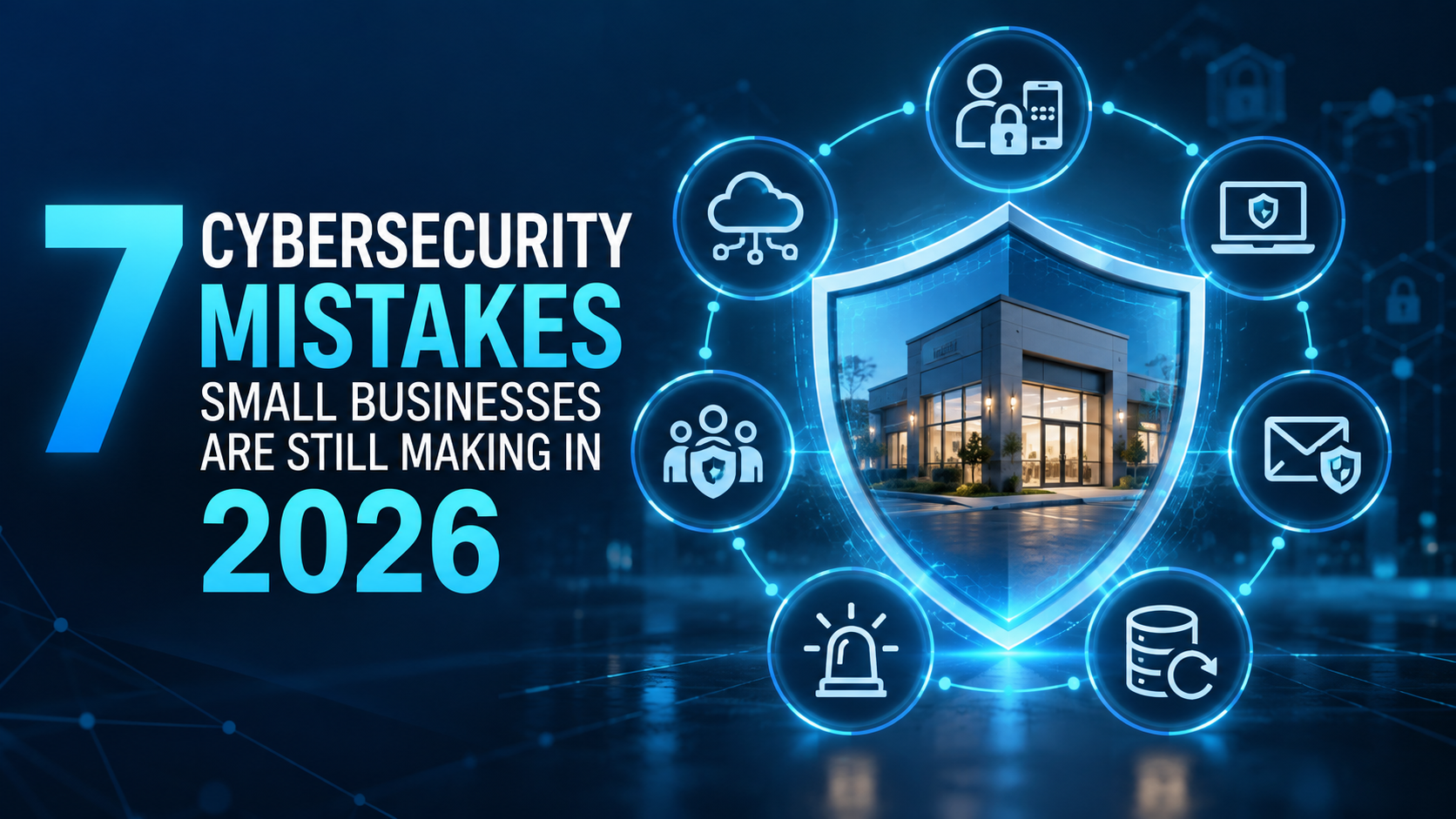
Here are seven cybersecurity mistakes businesses should address before they turn into costly security incidents.
1. Assuming MFA Makes an Account Secure
Multi-factor authentication (MFA) remains one of the most important security controls a business can implement, but MFA alone isn’t enough.
Modern phishing attacks can use adversary-in-the-middle techniques, malicious OAuth applications, stolen browser sessions, and social engineering to gain access even when MFA is enabled.
Businesses should combine MFA with additional protections such as:
- Conditional Access policies
- Risk-based authentication
- Device compliance requirements
- Geographic and impossible-travel monitoring
- Strong authentication methods such as passkeys and security keys
- Continuous monitoring for suspicious sign-ins
TBK Tip: MFA should be considered one layer of your security strategy—not the entire strategy.
2. Giving Users More Access Than They Need
Administrator privileges are convenient, but convenience can quickly become a security risk.
If an employee routinely operates with administrative permissions and their account or computer is compromised, an attacker may inherit those privileges.
Businesses should follow the Principle of Least Privilege, meaning users receive only the permissions necessary to perform their jobs.
This includes limiting local administrator accounts, separating administrative accounts from everyday accounts, reviewing Microsoft 365 administrator roles, removing access when employees change positions, and promptly disabling accounts when employees leave.
The fewer privileged accounts you have, the fewer opportunities attackers have to gain control of critical systems.
3. Thinking Antivirus Is Enough
Traditional antivirus software was designed primarily to identify known malicious files. Today’s attacks can behave very differently.
Attackers may use legitimate Windows utilities, PowerShell, stolen credentials, remote-management tools, scripts, and other techniques that don’t necessarily resemble traditional malware.
Modern businesses should consider Endpoint Detection and Response (EDR) or Managed Detection and Response (MDR) rather than relying exclusively on traditional antivirus.
These technologies can help identify suspicious behavior, investigate activity across endpoints, isolate compromised computers, and provide visibility into an attack before it spreads throughout the network.
Cybersecurity has shifted from simply blocking malicious files to detecting malicious behavior.
4. Having Backups but Never Testing Them
Ask a business owner whether their company has backups and the answer is usually yes.
Ask when those backups were last successfully restored, and the answer may be very different.
A backup isn’t particularly useful if it cannot be restored when disaster strikes.
Backups can fail because of configuration problems, storage failures, credential changes, ransomware, insufficient capacity, corrupted data, or simple human error.
Businesses should maintain multiple layers of protection, including appropriate onsite and offsite or cloud-based backups. Critical backups should also be protected from modification or deletion whenever possible.
Most importantly, restore testing should be performed regularly.
Your backup system shouldn’t simply report that yesterday’s backup completed successfully. Your business should know that its systems and data can actually be recovered.
5. Ignoring Email Security Because Microsoft 365 Already Has Security
Microsoft 365 provides important built-in security capabilities, but deploying Microsoft 365 doesn’t automatically mean every organization is appropriately protected against email-based attacks.
Email continues to be one of the primary ways attackers target businesses.
Common threats include:
- Business Email Compromise (BEC)
- Credential phishing
- Malicious attachments
- Fake Microsoft 365 login pages
- QR-code phishing
- Vendor impersonation
- Invoice and payment fraud
- Account takeover
Businesses should evaluate advanced email security, anti-phishing protections, domain authentication, suspicious forwarding rules, mailbox auditing, and employee security awareness training.
Employees should also have a simple way to report suspicious messages to IT.
One successful phishing email can potentially bypass thousands of dollars’ worth of security technology if the organization isn’t prepared to detect and respond to it.
6. Waiting Until an Incident Happens to Create a Response Plan
Imagine discovering ransomware on your network tomorrow morning.
Who gets called first?
Should employees disconnect their computers?
Who contacts your cyber-insurance carrier?
Who determines whether customer information was compromised?
How will employees communicate if email isn’t available?
Who has authority to shut down critical systems?
These decisions shouldn’t be made for the first time during an active cyberattack.
Every organization should maintain a Cybersecurity Incident Response Plan identifying responsibilities, communication procedures, escalation processes, important contacts, backup procedures, insurance information, and recovery priorities.
The plan should also be periodically reviewed and tested.
During a cybersecurity incident, having a documented plan can significantly reduce confusion when every minute matters.
7. Treating Cybersecurity as an IT Problem Instead of a Business Risk
This may be the biggest mistake of all.
Cybersecurity isn’t simply the responsibility of the IT department or managed service provider.
A cybersecurity incident can affect nearly every part of an organization, including operations, finances, reputation, customer relationships, regulatory obligations, and insurance coverage.
Business owners and management should understand questions such as:
What systems are critical to our operation?
How long could we operate without them?
What information would cause the greatest damage if it were stolen?
Who has access to our most sensitive systems?
How quickly could we recover from ransomware or server failure?
When was our disaster recovery process last tested?
Cybersecurity decisions should ultimately be based on business risk, not simply technology.
Cybersecurity Doesn’t Have to Be Complicated
Small businesses don’t need the cybersecurity budget of a Fortune 500 company.
They do need a layered security strategy.
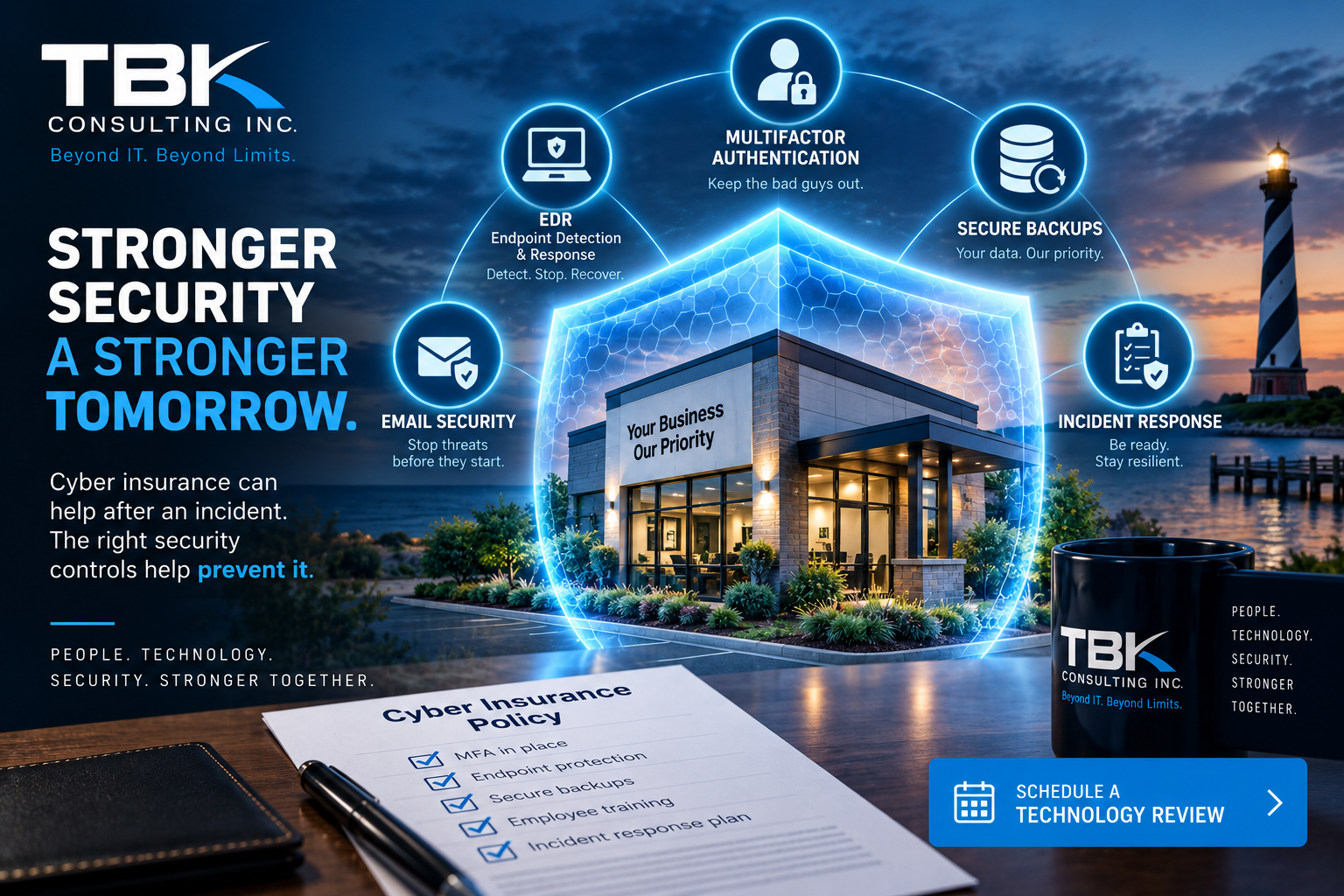
Strong identity protection, properly configured Microsoft 365 environments, endpoint detection, email security, security awareness training, reliable backups, continuous monitoring, and a documented incident response plan can dramatically improve an organization’s ability to prevent, detect, and recover from cyber incidents.
The goal isn’t to pretend that every cyberattack can be prevented.
The goal is to make your business difficult to compromise, quick to detect suspicious activity, and prepared to recover when something goes wrong.
How TBK Consulting Inc Can Help
TBK Consulting Inc helps businesses throughout the Outer Banks of North Carolina build practical cybersecurity strategies designed around their actual risks and operations.
Our managed IT and cybersecurity services can include endpoint protection, managed detection and response, Microsoft 365 security, email protection, dark web monitoring, security awareness training, backup and disaster recovery, network security, vulnerability management, and ongoing technology reviews.
Instead of relying on a single security product, we help businesses create multiple layers of protection while continuously reviewing where improvements can be made.
Is Your Business Making Any of These 7 Mistakes?
You don’t have to wait for a cybersecurity incident to find out.
Schedule a Technology Review with TBK Consulting Inc.
We’ll review your current technology and security environment, identify potential areas of risk, and discuss practical steps your organization can take to improve its cybersecurity posture.
TBK Consulting Inc
Beyond IT. Beyond Limits.
Comments are closed